

For 13 years, a blue checkmark next to your name meant that a mysterious shadow council had deemed you worthy. When I got my blue tick on Instagram, friends reached out to congratulate me. When friends got their blue ticks on Twitter (it was still Twitter then) and I didn’t, I questioned why my achievements didn’t matter enough.
Then Elon introduced paid verification, Meta followed suit, and none of it mattered anymore.
Reputation was always considered the “sticky” part of status, the least fakeable, but the metrics we’ve been measuring it by for the past century have lost their muscle mass (insert Ozempic quip here).
OUT: A huge follower count
IN: Niche creators (73% of Gen Z and Millennials trust smaller creators more than big influencers. YPulse 2026)
OUT: Big VC funding rounds
IN: Bootstrapping
OUT: Brand sponsorships
IN: Your own brand
OUT: Losing weight
IN: Becoming an athlete
OUT: Press coverage
IN: 10k Substack subscribers
Anything you can buy or network or GLP-1 your way into compresses the perceived cost of achieving those things. Even if you’ve got there through relentless hard work, the fact that others have been able to shortcut it cheapens your achievement and lowers your status.
For something to have far-reaching meaning, it needs to have come at an incompressible cost.
The ultra-marathon version of something, where you can’t shortcut a single part of the process, and even completing the process doesn’t guarantee the result.
Becoming a thought leader rather than a face. Mastering a highly specialised craft. Succeeding as an artist without famous friends or parents. Bootstrapping to a level of success where you can build whatever you want (see Midjourney’s pivot from AI image generation into medicine and spirituality). You cannot convincingly fake an incompressible cost.
These aren’t just hard things, but hard things not just anyone can do.
Status lives and dies on layers, and cost only becomes incompressible when time is one of the layers.
Geeks, mops, sociopaths and LARPability
AI researcher David Chapman described the lifecycle of subculture through three types of participant: geeks, mops and sociopaths. The geeks are the insiders who create the culture, the mops are later adopters who dilute the culture but provide an audience, and the sociopaths are the extractors who exploit the culture for money and power, until it’s dead.
The sociopaths’ ability to manipulate themselves into positions of high status has always been a skill, an art in itself.
But now, anything that’s fakeable has become easy for anyone to fake.
The more the playing field is levelled with tools to speedrun, shortcut and fake, the more cynical we become about what is LARPable and more trust we demand before handing someone power.
This makes it hard for sociopaths to function. You can’t impress someone with a trick they can also do.
“Geek” is an endurance sport
Geeks are defined by their cultural intelligence (CQ). CQ is slippery and subjective. Gaining it doesn’t guarantee keeping it, and to even find out where you sit on the scale, you have to risk humiliation. You can’t check against a textbook or a LLM, you have to put yourself in a public forum and be perceived.
Being a geek in one context doesn’t give you an automatic advantage in another. The requirements change from one geography to another, from social group to social group. And the rules, which were unwritten to start with, keep evolving.
To earn cultural intelligence you need a self-aware willingness to invite ridicule.
“Bad taste” is synonymous with CQ. You’re doing a bit and only people with the highest cultural intelligence will recognise it.
To have meaning, CQ must be niche enough that the references are only unlocked through immersion over time, but still recognisable enough that occasionally a random stranger salutes you.
Once the references become easily researchable, the geeks must change the rules to preserve status. In Charli XCX terms, this is following Brat with Music, Fashion, Film.
Subculture used to peak at mop adoption and slowly dilute as its references got widely known, giving the sociopaths ample chance to exploit late adopters. But in a post-algorithm world, dilution happens much faster.
Gen Z have taken subculture further underground than it’s ever had to be before, into tiny micro-scenes. The groupchatification of subculture.
If it hits social media, in most cases it only goes viral within a small pocket of the algorithm, so although it feels like saturation to those inside the pocket, the average person still has no idea.
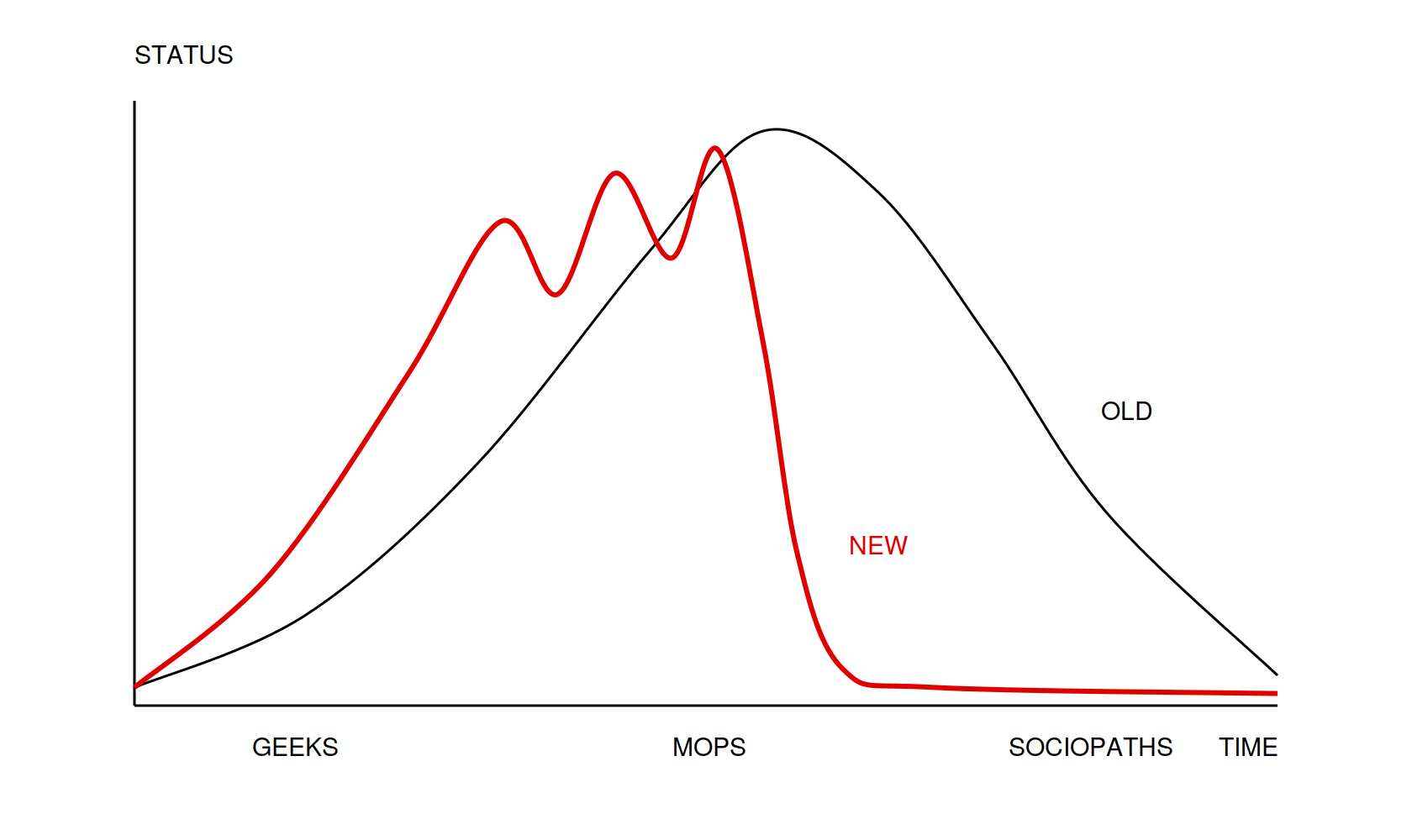
This gives the geeks much more control if they want to earn from the culture themselves, before the sociopaths have an in. They can incubate AND scale at the same time, which is new.
Courtney Love talked about this back in 2000, the power the internet would give to artists, although it’s taken longer than she’d hoped:
“Maybe each fan will spend less money, but maybe each artist will have a better chance of making a living. Maybe our culture will get more interesting than the one currently owned by Time Warner.”
Geeks now have so much control over their own distribution that if their subculture does hit real mainstream, they can kill it and make new rules, with a new barrier to entry. In Charli XCX terms this is following Brat with Music, Fashion, Film.
Geeks are endurance athletes.
By the time they’ve made marathons cool, they’re already running ultra-marathons. Sociopaths used to get away with faking their distance on Strava but the mops have learned how this trick works. If no one’s seen you in an actual race you don’t get handed power. Even if the sociopaths start training, they’ll never catch up in time to sell to the mops before the geeks can.
The new rules of status
We are currently in a status hangover. Achievements that were once heavy markers of status have been losing weight for a while. We haven’t quite reorganised our value system yet, so we fall back on to old rules, despite their growing irrelevance.
Borrowing Stewart Brand’s Pace Layer framework, which categorises systems by their fastest to slowest moving layers, I’ve laid out the new rules of status into its own 6 layers, from most compressible to least compressible.
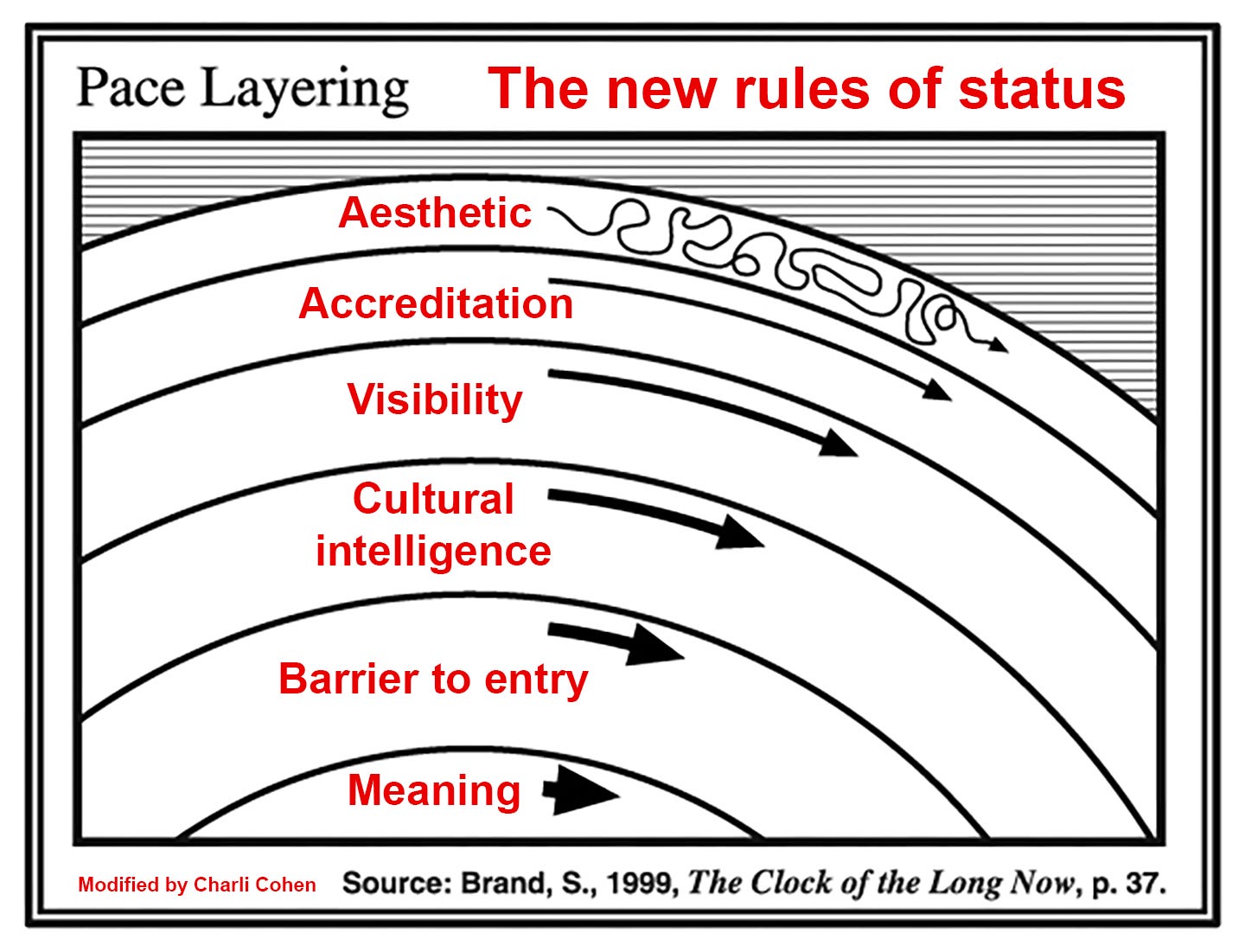
Aesthetic: money. Fully compressible, cultural status dissolves once enough people can buy the optics of the slow layers.
Accreditation: talent × network. Network is compressible, talent compresses as the accreditor scales and/or starts to value Aesthetic over Barrier to entry e.g. Forbes 30 under 30, Y-Combinator, Soho House.
Influence: attention x time. Attention becomes less compressible the longer its sustained.
Cultural intelligence: immersion × time. Less compressible the deeper the references are.
Barrier to entry: learning curve × risk. Incompressible, the tolerance to fail or be an outsider over time.
Meaning: earned belonging × earned reward. Incompressible, the foundation everything re-forms on.
The blue check got bumped from Accreditation to Aesthetic overnight. Accreditation itself is a much faster layer than it once was. Soho House accelerated from Cultural intelligence to Aesthetic, along with Margiela tabis, which used to be a Barrier to entry.
We mostly see AI as a compressor, but as a medium it has its own set of layers. An artist who fine-tunes a model with their own original work is cooler than one who just prompts, because of the Barrier to entry. Both take the social battering of being an “AI artist” but the first has mastered a steeper learning curve.
True status ceases to exist outside of the slow layers and that means most people won’t understand it.
There is no longer a generic marker of true status. Fame and fortune aren’t cool without the slow layers, and by design only a certain number of people will understand a particular set of slow layers as cool.
Society is still playing catch up, but I believe these new rules are where we go next. When the alternative is everyone falling irretrievably into a brainrot coma, I choose to put my faith in humanity’s long-standing search for meaning.
Really interesting. Will be thinking on this for a while!
Yes. There is a cultural leadership vacuum is between old value systems and new ones. This is a big opportunity for anyone who already exited old value systems a while back, and whose work consequently offers a new one!