

For the best part of a decade the number one dream job for teens has been YouTuber. This used to mean brand deals, publishing deals and getting comped with all the trappings of a luxury lifestyle. But increasingly, for Gen Z and Alpha, it’s a route to launching their own company.
In 2020, being invited to join a creator house was the pinnacle of status. Creators were given free board and a platform, in return for aggressive exclusivity clauses and an equally aggressive cut. The most famous of these, Hype House, sold in 2024 after losing most of its big names.
Even faster than the Creator House’s fall from grace, has been the Tech Accelerator’s meteoric come up. Y-Combinator applications have doubled since 2022, up to 40,000 applications per cycle. As exclusive as invite-only Hype House, YC’s acceptance rate is just 0.6%.
An accelerator takes equity in your company in return for mentoring, network and hard cash. But at the end of it, the company is still yours.
The creator economy is a rent model. You rent a platform. You rent and rent out an audience.
The founder economy needs an ownership model. You own your platform, your audience, and the thing you’re selling to them.
Companies are content
You can now vibe code an app in less time than it takes to edit a TikTok. Lovable has 200,000 new projects a day. App Store submissions are up 84% year on year. The app strategy is a content strategy: spot trends, ship daily, do more of what works, move on from what doesn’t.
A company no longer has to be your life’s work, or to even have a significant lifespan: you can build a portfolio of micro-companies. Every micro-company builds your status as a founder until the people with money are watching to see what you do next.
It’s a native playbook for teenage founders. 19 year old Zach Yadegari sold calorie tracking app, Cal AI, to MyFitnessPal, having reached $50M annual recurring revenue. 3 years earlier he sold a gaming site for $100,000. He then tried and failed with several apps before the success of Cal AI.
The new meaning of Founder
Safer than getting a job
Gen Z watched their parents struggle through a recession we never really recovered from. Gen Alpha have a front row seat to the AI fallout. A job is no longer the safe choice over self employment.
Even their perception of self-employment is different. They’ve learned from their parents’ generation that putting all your eggs in one career basket doesn’t pay out the way it used to. It’s safer to hedge your bets with multiple revenue streams from a portfolio of projects.
Gen Z are seen as risk averse when the real fear is being witnessed making a mistake. As a founder, failing fast is a celebrated part of the process. You can even test things out pseudonymously until you’re definitely on to something (younger gens have been doing this in games for years). You can craft your public image and keep your learning curve entirely private. For the stakes to be high enough for a public failure, you have to succeed first.
Meanwhile, the tools to build something of your own and to get it in front of people are at an all time high. A levelled playing field makes the competition more intense, but does it really feel that much more difficult than finding and retaining a good job? You have to get used to rejection either way.
At least as a founder, what you have at the end of the struggle is yours.
Cooler than being an influencer
If you once dreamed of being an influencer, being a founder promises to give you more, for a similar level of effort.
“Influencer” has become a loaded term; it’s gauche to self-identify as one. “Founder” feels higher value, it implies you’re building something greater than yourself, and it’s still an acceptable way to label yourself.
You can achieve high-level founder status without a highly successful company: get into an accelerator, raise a pre-seed round, sign up partners. All these happen long before tangible success does. Other people believing in your potential for success is enough.
To be considered successful as an influencer, you need to have already built your following as a content creator. The brand deals need to have actually materialised beyond an announcement. Your own product lines need to have launched and sold out. Your status is retroactive.
Practically, the founder and influencer paths are very similar, so why wouldn’t you choose the label that gives you greater status, faster. 10 years ago that label was influencer. In 2026 it’s founder.
The creator economy hangover
The current influencer to founder trajectory is more of a label change than a culture change. Founders borrowing their strategy from the creator economy are also inheriting its pain points. Like the content creators before them, content companies are over-reliant on external platforms and algorithms.
This creates two major weaknesses:
A platform as a single point of failure for the company
Cal AI’s growth came via 150+ TikTok ambassadors, paid a monthly retainer, 12 of its own TikTok accounts, with paid ads and affiliates layered on top. Cal AI has no real community of its own: once they’re subscribed, their interaction is with the app, not with other users.
What happens if Cal AI’s TikTok presence is compromised? Say they link it to eating disorder content and start penalising any mention of it. Or introduce age verification measures that kill the audience. Though Cal AI’s subscribers wouldn’t be directly affected, its growth engine would be wiped out and it would have to rebuild its distribution somewhere else.
If having to rebuild a paid community of ambassadors and affiliates is hard, being forced to rebuild an organic community can be catastrophic.
You may remember the 2019 Mixer exodus. Microsoft paid prolific Twitch streamers Ninja and Shroud tens of millions to move to their competing platform. Most of the audience didn’t follow and Mixer shut down within a year.
What Microsoft didn’t factor: the status attached to being part of Ninja and Shroud’s community was intrinsically linked to being part of the Twitch community; sub badges, emotes and all.
A founder with no community of their own
If today’s founder treats companies like content, the things that should compound longterm, as they move from idea to idea, are their worldview, their professional network and their community. But a community that’s tied to a specific platform and a specific project are unlikely to follow a founder to their next idea. The effort of switching platform, and getting excited about something new that might be totally unrelated to the first company, needs a disproportionately high incentive.
For the Roblox builders, what happens when they (or their community) age out of the platform? For the TikTok brands, what’s next once the trend cycle moves on?
Your platform > your community > your company
Any founder who wants real agency, real security, needs their own platform. The platform is separate from any one company, but acts as distribution for all of them. It’s where each company’s community lives, and where a Venn diagram of community overlap is able to compound from project to project. The main purpose of building in public should be to grow this core community, people who feel as connected to the founder as to the companies being built.
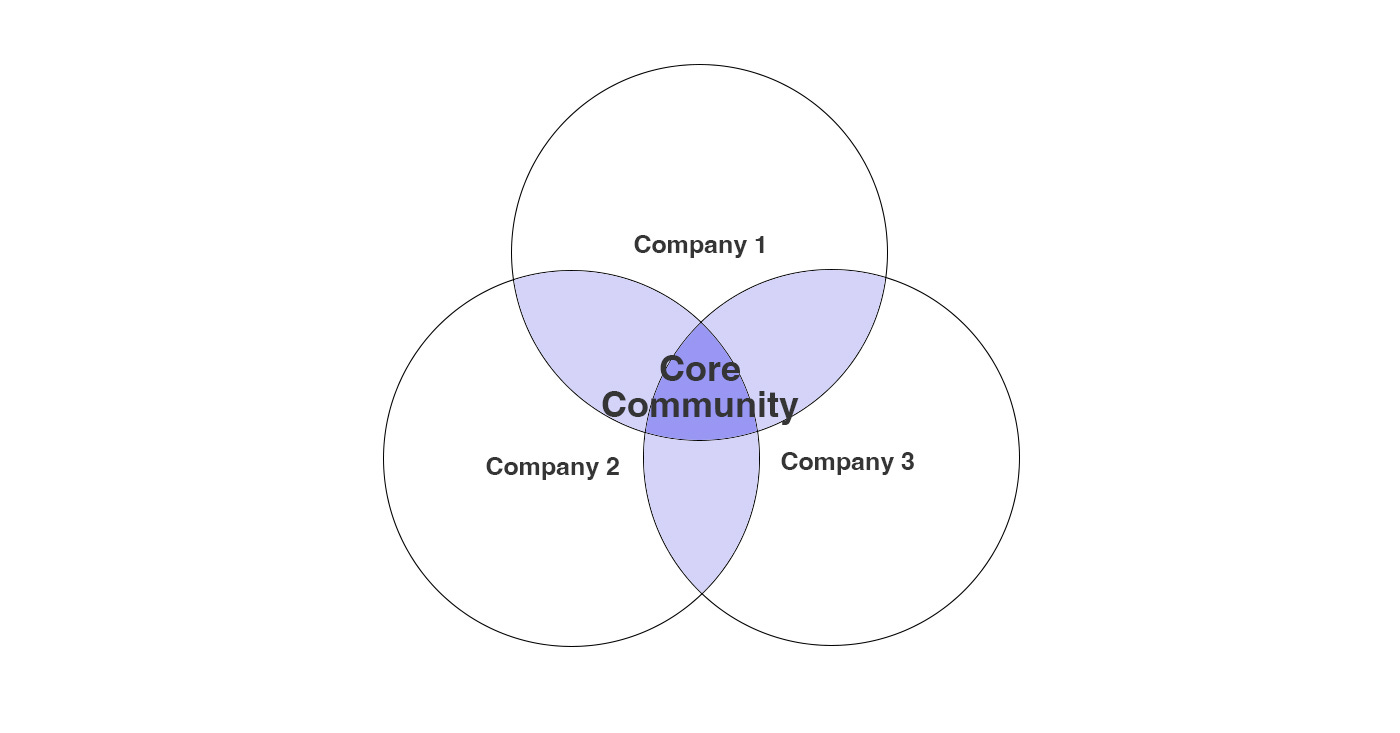
For a founder-owned platform to be viable, it needs its own status and its own network effects. There are two ways to approach this:
Building a local offline community or a private, invite-only online community to become the first adopters of your platform (the status of being part of the community is already established).
Leveraging the incumbent social media platforms for initial reach, then funnelling community to your platform with incentives (the community needs to perceive your platform as meaningfully higher status).
Different archetypes of founder will suit one approach better than the other, e.g. option 1 for an artist in Brooklyn vs option 2 for a software developer in rural Indiana. Most can benefit from combining the two.
Fans, users, or a secret third thing?
Whether paid, organic or mutual back-scratching, collaboration is how you get your company out there.
As a content creator, you’re limited in how you can collaborate with others, and who those others are, because your output is a direct extension of your image. A founder might feel like their company is an extension of them, but it’s also its own separate entity, which makes it much easier to leverage collaboration as a distribution strategy.
In the creator economy, you have creators and fans, but there’s also a significant community of fan-creators. This middle group is either labouring out of love for their favourite creator, or strategically aligning themselves to build their own creator status. Both subsets provide important distribution, and both help a creator retain mindshare.
The founder economy’s middle group will be even more multi-hyphenate. User-fan-founders will join a product community, progress into the founder’s core community, and use that as a launchpad for growing their own founder community. Their efforts, in turn, continue to build the original founder’s community and their product’s distribution.
Rethinking “economy”
A founder-owned platform is the only efficient way to serve this middle group and the only real way to leverage them without exploiting them. The creator economy has a linear value chain: the platform extracts from the creator, the creator (perhaps unintentionally but by design) extracts from their community, and the community are bottom of the pile. When a community member, through fan-creation, rises to the top of their group, they are better off breaking away and starting a new value chain that they can at least sit higher up on.
When a founder owns their platform, they can introduce circular and compounding flows of value that reward user-fan-founders for staying in their ecosystem and through that, amplify the platform’s success. These UFFs can co-own the platform with the original founder.
When someone adds value to the project portfolio, they can earn a share of the portfolio’s overall revenue that correlates to that value. For example, someone makes a spin-off app, earning the bulk of their own app sales and paying a small royalty back to the ecosystem. Based on the overall value the app is adding, income, attention, new users, community approval, its founder earns a bonus revenue share from the collective portfolio.
I wrote here about building post-institutions: instead of fighting a broken establishment, we need to replace it with viable new systems. The creator economy is the institution: the illusion of agency at the expense of other people’s agency. The founder economy, done right, is the post-institution: real agency that enables other people’s agency.